Dogs with separation anxiety often begin showing distress before the owner has left the house.
The phone rings at 8:45 a.m. and the neighbor reports that the dog has been barking since 8:05, forty minutes of continuous vocalization. The owner has been gone forty minutes. This is not a coincidence, and it's not the dog being difficult.
Dr. Malena DeMartini-Price has treated separation anxiety in dogs full-time since 2003. She wrote the most used clinical protocol for the condition and trained hundreds of behavior consultants to use it. She starts every client conversation the same way. "The dog is not doing this to you. The dog is not doing this on purpose. The dog is genuinely afraid."
Separation anxiety affects an estimated 14 to 29% of dogs, according to research published in the Journal of Veterinary Behavior. It is one of the most common reasons owners surrender dogs to shelters and the most common presenting problem for veterinary behaviorists. It is also one of the most treatable conditions in canine behavioral medicine, when the treatment is applied well.
What Happens in the Dog's Brain
When a dog with separation anxiety is left alone, the brain activates the same stress-response circuitry that would fire if the dog faced a direct threat. The amygdala, the brain's fear center, triggers the hypothalamic-pituitary-adrenal axis. Cortisol floods the system. Heart rate climbs. The prefrontal cortex, the part of the brain that handles decision-making, goes offline.
This is why punishment doesn't work and makes things worse. Punishment delivered after the fact, when you return home to find destroyed furniture, reaches a dog whose cortisol has normalized and who cannot connect the punishment to a behavior from an hour ago. What the dog learns is that your return predicts bad things. Approach anxiety compounds the separation anxiety.
Dr. Karen Overall, a veterinary behaviorist who has studied anxiety in companion animals for decades, describes separation anxiety as "a panic disorder." The terminology matters. You can't train a dog out of a panic disorder with sit-stay practice.
"Separation anxiety is not a training problem. It's a welfare problem. The dog is suffering, and what that dog needs is systematic desensitization, not discipline."
Dr. Malena DeMartini-Price, behavior consultant and author of Treating Separation Anxiety in DogsWhat Separation Anxiety Looks Like
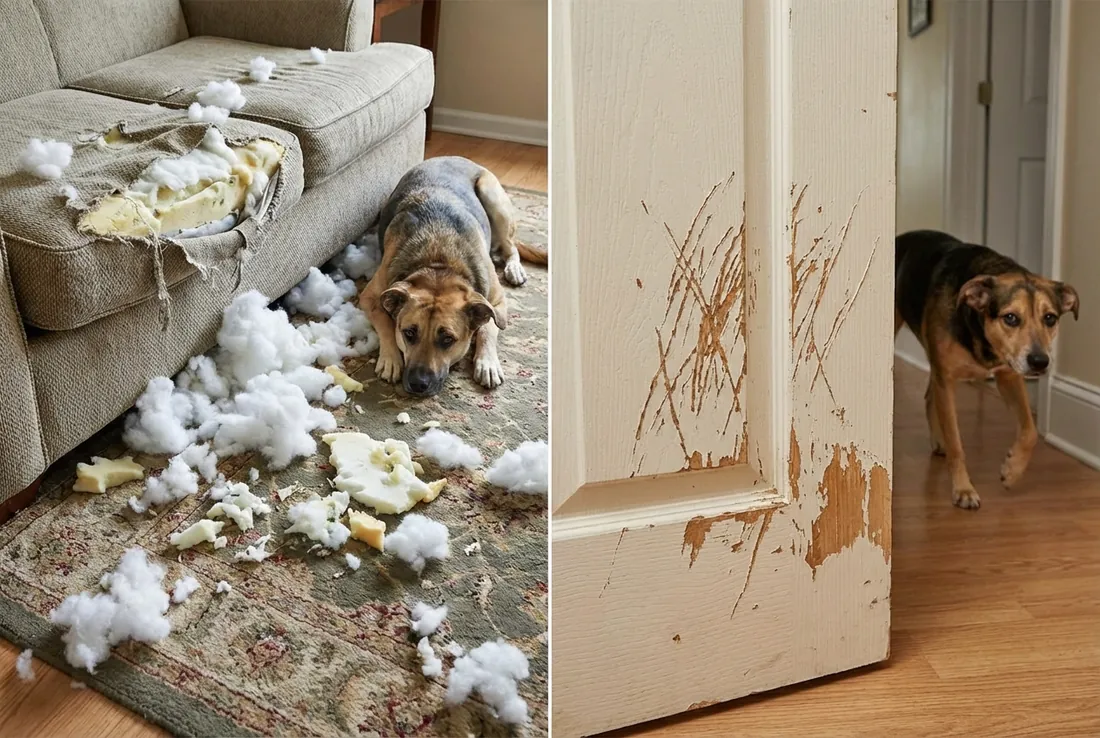
The behaviors owners report: destructive chewing concentrated near exits (doors, windowsills), excessive vocalization, house soiling from a dog that is otherwise housetrained, self-injury from escape attempts (broken nails, bleeding paws, chipped teeth), and refusal to eat when alone, even from a dog with a strong food drive.
One diagnostic clue stands out: the behaviors occur only when the dog is alone, or when left with someone other than the primary attachment figure. A dog that destroys furniture every day but only when home alone has a separation problem. A dog that destroys furniture when people are present has a different problem. Owners mix these up.
Video footage is the most reliable diagnostic tool. Set up a phone camera before you leave. Watch the first ten minutes. A dog with separation anxiety will begin showing distress signals, panting, pacing, whining, sitting at the door, within two minutes of the owner leaving. The difference between separation anxiety and boredom becomes obvious on camera.
The Desensitization Protocol
The evidence-based treatment for separation anxiety is systematic desensitization: graduated, sub-threshold exposure to the trigger (being alone) until the dog's emotional response changes. The word "systematic" is doing the work in that sentence. Random exposure to being alone doesn't help. Gradual, sequenced exposure does.
The protocol begins before the owner leaves. DeMartini-Price's approach starts by identifying each "pre-departure cue" that triggers the dog's anxiety: picking up keys, putting on shoes, reaching for a jacket. These cues acquire predictive value before the owner has reached the door. Treatment begins by defusing those cues, performing them dozens of times without leaving, until they no longer predict absence.
After pre-departure cues are neutral, the protocol builds duration in small steps. The owner leaves for three seconds and returns. Then five seconds. Then eight. The progression follows the dog's response, not a fixed schedule. If the dog shows any distress signal at ten seconds, the next session goes back to eight. There is no rushing this. Owners who try to speed up the timeline extend it instead by pushing the dog past threshold and reinforcing the anxiety response.
Complicating Factors
Several factors complicate treatment. First: the dog must stay below threshold during treatment, which means no full absences while the protocol is in progress. This is the part that strains owners most. Going to work means finding a dog sitter, daycare, or a remote working arrangement for the duration of treatment, which runs weeks to months depending on severity.
Second: many dogs habituate to certain people but not others. The primary attachment figure is the person who matters. If that person travels for work, the dog's condition may be severe enough that desensitization must be supplemented with medication.
Third: some dogs have concurrent health conditions that worsen anxiety. Pain from conditions like arthritis or gastrointestinal disease lowers stress tolerance. A dog that was coping with being alone may decompensate when an unrelated medical issue develops. Ruling out physical contributors is part of the workup.
Medication Options
Medication is not a last resort for severe separation anxiety. It is a tool that makes the behavioral work possible. A dog in full panic cannot learn. Reducing the anxiety response with medication creates a cognitive state in which desensitization training can take hold.
The two most prescribed medications for separation anxiety are fluoxetine (Prozac) and clomipramine (Clomicalm, the only FDA-approved veterinary drug for this indication). Both are SSRIs or tricyclic antidepressants that work over weeks, not on the day they're given. They reduce baseline anxiety and lower the frequency and intensity of panic responses. They work best with behavioral intervention, not as a substitute for it.
For acute episodes, some veterinarians prescribe situational medications like trazodone or alprazolam to manage a specific high-stress event (a thunderstorm, a trip to the groomer) rather than daily life. These are not separation anxiety treatments, but they can prevent setbacks during desensitization.
The medication conversation belongs with a veterinarian who understands behavioral pharmacology, or a board-certified veterinary behaviorist. The ACVB (American College of Veterinary Behaviorists) maintains a directory of diplomates at dacvb.org.
What Doesn't Work
A few interventions persist in popular advice that have no evidence base and can worsen the problem. Flooding, exposing the dog to full absences and waiting for it to "get used to it," does not extinguish panic responses. It creates learned helplessness: the dog stops expressing distress not because it feels better but because it has learned that distress doesn't help. The physiological panic response continues underneath.
Getting a second dog sometimes helps and sometimes creates two anxious dogs. If the separation anxiety is about the absence of the primary owner, a second dog doesn't address the root cause. If the dog is anxious about social isolation in general, a second dog may help. This distinction matters before bringing another animal into the household.
Punishment for post-departure destruction, whether a remote-activated shock collar or scolding at the door, worsens outcomes. The dog's behavior during alone time is not voluntary. It is a symptom. Punishing symptoms does not address the condition.
The Recovery Timeline
DeMartini-Price's published research on 52 dogs treated with the systematic desensitization protocol found that 76% showed measurable improvement within 60 days. Improvement was defined as the dog tolerating a 90-minute absence without distress signs.
Full resolution, where the dog is comfortable for the owner's full work day, took longer in most cases. Severity at intake was the strongest predictor of treatment duration. Mild to moderate cases (distress starting after 10 minutes) resolved faster than severe cases (distress starting on departure).
The work is slow. It requires discipline from the owner, not the dog. But the neurological changes that happen over the course of systematic desensitization are durable. Dogs that complete the protocol don't relapse unless major life changes, a move, a new work schedule, a death in the family, disrupt the stable environment the treatment built.